




WOODBURY一 Many young people are anxious to get their first job, but they repeatedly encounter the same challenge: “experience required.”
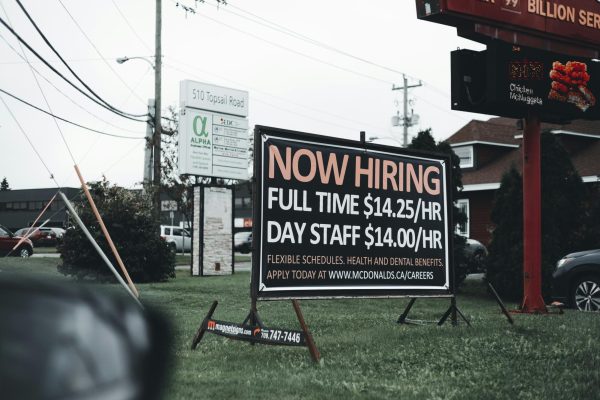
There are “Help Wanted” advertisements all over malls, fast-food restaurants, and supermarkets, yet managers often choose workers who are already trained and know how to interact with customers, operate cash registers, and work busy shifts. For teenagers without any work experience, this leads to a frustrating situation. They are unable to find work without prior experience, but they cannot gain that experience if no one is willing to hire or provide their training.
This vicious cycle spells trouble一and unemployment一for young workers.
“I faced challenges due to the limited job opportunities and finding places my parents could drop me off at before work and pick me up from afterward. Additionally, there were issues with age limits and employers being hesitant to hire young people.” said Isabelle Longly, a senior at Nonnewaug High School. “I continued searching for employment throughout the summer while volunteering at my local dog shelter to accumulate hours for the FFA. Most of the other places I contacted did not respond. Many farms do not have the budget to pay multiple workers at a high wage and they always pick the more experienced candidates, leading them to let go teenagers.”
In recent years, labor statistics have shown that many farms operate with very tight profits, which affects how much they can pay their workers. As costs go up, layoffs are soon to follow.
Another student that has felt the burden of trying to find a job is Mumtahina Alam, a senior at Nonnewaug High School.
“Finding a Supervised Agricultural Experience (SAE) when I transferred here as a sophomore was quite challenging; I didn’t know how to apply for jobs or what I wanted to do as a job. I finally got an SAE in May of my sophomore year. It was extremely tough to find a job that didn’t require someone to be over 18, and I was only 15 at that time.”
For students like Alam, age–and experience–are major factors in finding employment.
“Job opportunities heavily rely on age, experience, and the time of year. At this point, I have been searching for jobs outside of the SAE since I am going to college in a few months, and I believe it would be beneficial to start saving,” Alam said. “In the past, I faced challenges because the minimum working age is 16, and the school expects 14 or 15 year olds to get a required 200 working hours.”
Teens not only have to deal with the struggle of not being able to find a job, they also have to deal with minimum wage increases making it more challenging for them to get one.
“I don’t think it’s too much of an issue with the increase in minimum wage because I think it will motivate more individuals to go find jobs, especially with the minimum wage set at $16.94 an hour,” Alam continued. “However, there was a challenge at my previous job in the garden center as it began to go out of season, this led to plants dying, which resulted in less customers, which led to less money. Eventually, they told me they couldn’t afford to keep me, and before that, they decreased my pay to below the minimum wage.”
The experiences of teens like Isabelle Longly and Mumtahina Alam show how difficult it can be for young people to enter the workforce when employers demand “ready made” workers but refuse to invest in training them.
Harriette Bayliss, a freshman at Nonnewaug High School, also agrees with her peers about the struggle of finding a job.
“Finding a job at 14 years old has been pretty much impossible, as not many employers hire teens at this age. Even if I was going to get hired there are so many labor laws that limit my hours,” said Bayliss. “I would go out and try to apply to different stores and places but the minimum age is 16, but for my SAE, I need a job related to agriculture, but there are very few. It’s also hard because I can’t drive and my parents work so that also limits the opportunities I have.”


