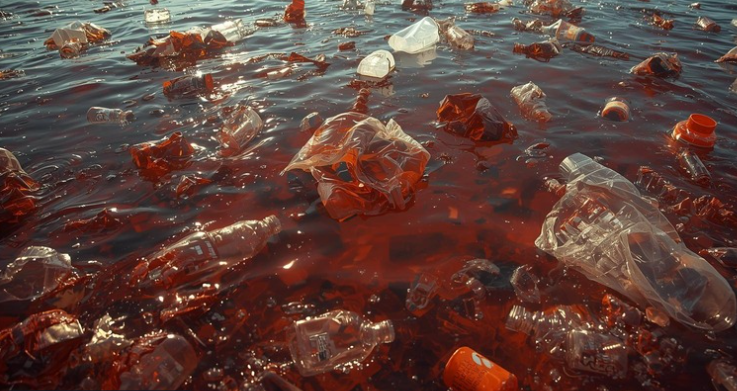

WOODBURY – Imagine a world full of the most beautiful colors, plants, and animals. Somewhere that so many thrive and depend on. This is your world as a sea creature, well, at least it was.
Your world so full of colors and vibrance and life, and is now covered in sticky oozing grease from factories and boats; there is plastic covering the beautiful tapestry of coral reefs, and worst of all, the lives in the sea are thriving no more: they are choking to death on plastics and struggling to breathe with the chemicals.
Your once stunning aquatic home is now a junkyard of death.
These are the horrific effects of ocean pollution, ocean pollution that we barely even realize is right under our noses.
So what exactly is ocean pollution in the first place, and what causes it?
Ocean pollution is caused by buildup of man-made plastics, chemicals, and toxic liquids from human trash disposal and machinery debris.
Agriculture teacher Eric Birkenberger understands the consequence of pollution in the world’s water systems.
“People should try and do the best they can in order to reduce the amount of pollution to hopefully have a cleaner world for our children, grandchildren, and future generations,” said Birkenberger. “For example, instead of fossil fuels I think we could do more with alternative energy wind turbines and solar power machinery. Anything that we can do to reduce emissions should be encouraged. But then there’s also pollution like garbage. I know there’s a lot of states that don’t have recycling policies and requirements. I think that it should be a national thing that recycling is required.”
Ocean pollution isn’t just unsettling, but very dangerous to humans and many other organisms.
Ocean pollution affects animals and the rest of the environment by killing and injuring millions of marine animals by getting tangled and stuck in plastic materials and nets, ingesting toxic chemicals from machinery, choking on, and eating man-made trash and destroying their habitats.
The accumulation of this pollution affects the rest of the environment by killing off animals and destroying food chains, affecting humans and land animals too, it creates weak oxygen around it, and spreads trash and chemical-caused diseases which spreads to prey animals and the predators from eating them. Ultimately, this ends up killing thousands of animals and people who can consume it. People ingest microplastics through food, too, which builds up in their bodies causing many health problems.
According to Nonnewaug aquaculture teacher Leanne Foster, the impact of microplastics and pollution, overall, are beginning to show their long term impact.
“I think there’s also a lack of general education about oceans so I think people don’t understand accessibility, having them dumped into the ocean,” Foster said. “I think people feel that they use water to wash away things and everything along those lines. They feel that they can just put whatever they want in the ocean.”
For educators like Foster, addressing these issues begins with educating the world on the dangers of pollution.
“I think if we just are able to have a little bit more education, awareness, and the want to help would be at a much better rate,” Foster said.
Agriculture student Esdras Castellanos appreciates his class’ awareness of large-scale issues related to pollution and the discoveries that are yet to be made.
“She makes me feel like there’s more to explore because nearly 90% of the ocean floor has not been discovered yet,” said Castellanos.
Castellanos’s experience shows proof of how just a bit of education about the environmental world can inspire someone to want to know more, ask questions, and look for opportunities to help.
Ultimately, our planet’s oceans need help, along with so many other ecosystems of the environment. Education is the key to awareness, and the earlier people are educated, the longer they have to help.