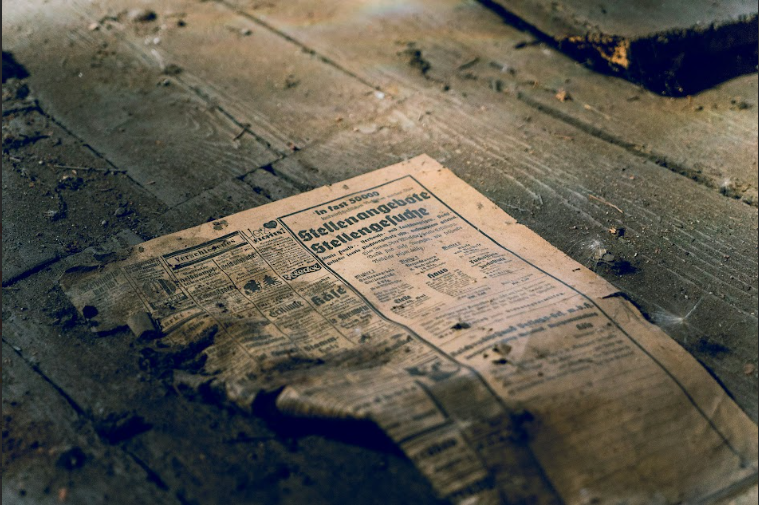
WOODBURY – When was the last time you read the news? And no, 15 second TikToks from random influencers reciting their “how has no one heard about this?!” spiel, doesn’t count. Those Democrat Vs Republican debates on CNN don’t count, either. Are you truly ‘staying informed’, or are you just feeding into a political entertainment echo chamber? The fixation on these content forms has made people blind to what actually happens in their communities.
Paper Ghosts
To really put this into perspective, here’s some cumulative data: “Less than 25 years ago, the United States had approximately 40 journalists per 100,000 residents, on average. Now, that number has fallen to 8.2, about a 75% decline,” according to the Public Relations Society of America (PRSA).
This decrease is abysmal, and frankly, disheartening.
But this phenomenon isn’t anything new – Penny Abernathy (Professor, Hussman School of Journalism and Media, University of North Carolina), a former executive at the Wall Street Journal and the New York Times, has been studying this since 2020.
Through Abernathy’s research, she coined the term ‘ghost newspapers’, papers “operating as shadows of their former selves and lacking the financial resources and manpower to fully cover their communities.” Society runs on money, and if it’s not available, then there’s no incentive in capitalist America. Furthermore, this goes against the values of traditional journalism.
Marisa Holtman, an English teacher at NHS and a former journalism instructor, shares her perspective.
“I think that journalists and reporters value independence and direct access to sources”, Holtman says.
It’s almost impossible to get that in today’s world.
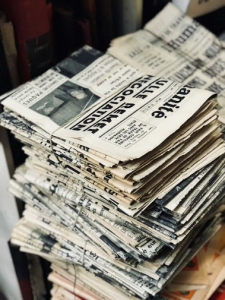
A similar decreasing trend was observed in the Great Recession of 2008, and again in 2019, following COVID-19. Since the spread of the pandemic, more than 300 newspapers closed, along with 6,000 journalists fired, and the cherry on top being over 30 newspapers shutting down or merging with large media conglomerates.
Today, online news sites feel more like graveyards than information hubs.
The Crux and its Consequences
Various issues arise from the lack of local media coverage, the icing on the cake being the insidious effect on American democracy – polarization, lack of government accountability, and the reduction of voting. According to Jeremy Stoddard and Diana E. Hess, ‘The Effects of Political Polarization on Social Studies Education and What We Should Do, polarization – specifically political, is “the movement of political views and actions away from the center and toward more extreme views and policies,” especially without nuance.
A Democrat won’t bother watching Fox News and a Republican won’t bother watching CNN because those news agencies have become more biased. But somehow, people are eager to tune in every night to feed their insatiable echo chamber.
“State and national news continue to get covered, you will always know what’s going on in the federal and state government,” said Kyle Brennan, a history teacher at NHS, a journalist of 20 years, and member of the Beacon Falls Board of Finance. “Where the cuts of reporters and newspapers really hurt, is that a lot of people no longer have any idea what is going on in this local community and local town governments.”
One of the most relevant instances are the recent budget cuts to education referendums that take place across the state, annually.
“When I first started [Beacon Falls Board of Finance] in 2018, our budget process used to be covered by our local newspaper,” Brennan said. “Now, over the last three years, I have not seen a single reporter at any of our budget meetings.”
The information is still there but people have to go search for it or attend the town meetings on their own – naturally, a lot of people don’t want to do that. Newspapers used to bring the information to the people. Good reporters would shed light on corruption in local government or consumer problems. In some ways, at the local level, there’s nobody to stand up and highlight issues people are facing. It harms the quality of life in local communities.
“Give them bread and surfaces, and they will never revolt”
A saying in Ancient Rome – it means, keep the people entertained, and they won’t bother questioning authority. This is the philosophy of the media conglomerates that imbibe local journalism.
The media business only values clicks and views. People post stories that have some type of bait, whether it be rage or sympathy – just to get people to engage. It is now all about making as much money as possible instead of doing the right thing.
“Big news channels are great for breaking news, but terrible for balanced analysis”, Holtman says. “I think that this waters down the news we receive which makes it difficult for people to stay informed.”
The future of journalism is seemingly on life support, and for NHS faculty, what’s ahead will require students to parse fact from fiction.
“Ultimately,” Holtman says, “it will require us to be discerning of the information that is given to us.”