
WOODBURY – The millennial generation is known for its distinctive pop culture, vibrant new fashion like neon colors, big hair, rise of MTV and nostalgic blockbuster movies. This era was also defined by face to face connection, at the mall, arcade, Radioshacks, and your friend’s favorite hang out spots. Whereas opposed to today those places are replaced by the virtual illusion of something far less meaningful: screens. And not only has it taken those places away but it also is taking people’s social skills and interaction that were defined in a generation.
The rise of the digital age was opened up as a way to connect and innovate for children but what we don’t realize is that it’s slowly taking away our world’s social future.
Our whole world is oblivious to the decline of the kids and teens’ social cues of this generation.
We can’t make eye contact.
We don’t know how to act in public.
And we don’t have common courtesy.
I myself spent a predominant amount of my childhood with my grandma and grandpa.
Now my grandma was a well respected lawyer in Connecticut and she taught me how to be polite and courteous to others and gain social skills not through a screen.
This familial legacy was all built with face to face interactions.

Similarly, my grandpa was a contractor for his whole life and he taught me how to be outside all day learning skills that most adults don’t have today
Learning how to use different tools, measuring different types of projects, and all sorts of things.
“It sucks to see kids so addicted to technology and grow up so dependent on it because it’s not a natural way of having fun,” said Nesim Iljazi, an NHS senior. “I have always been sociable, so to talk to younger people it’s a noticeable difference in language and politeness.”
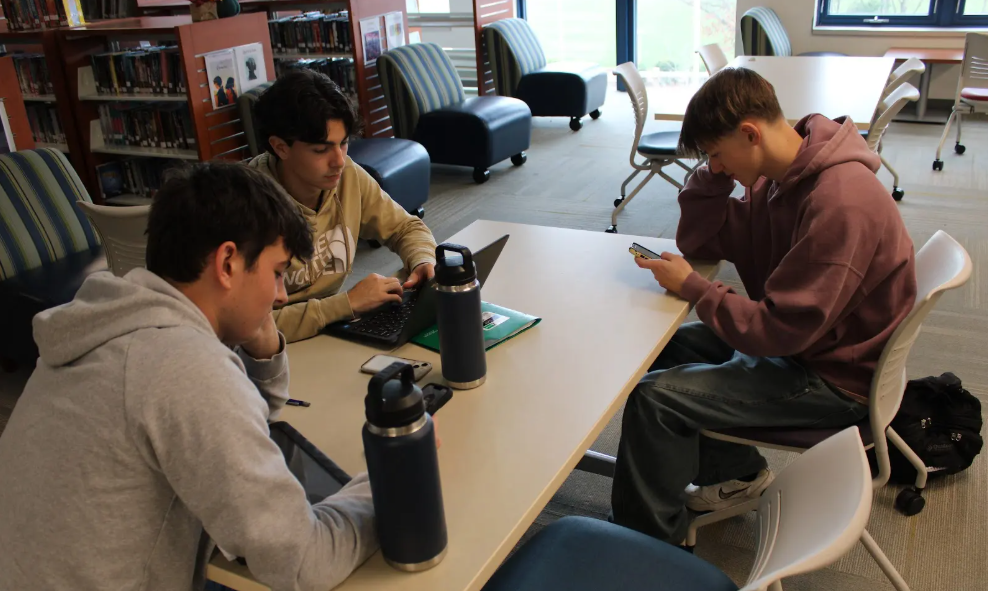
Kids just as young as the age of 11 get their own smartphone and 16-17 year olds pick up/use their phone 200 times a day when the healthy amount is under forty… if that’s not concerning I’m not sure what is.
“They do spend some time watching some TV shows. Unfortunately, there’s sometimes drawn in short video clips, TikTok-like things, which certainly are designed to draw attention of not just anybody, but little people in general. And yeah, it can be addictive. So we try to do plenty of stuff outside and not spend a lot of time on screens,” said Nick Sheikh, NHS science faculty who is a member of a generation that preceded this modern digital era. “We’ve talked about the importance of how tech is designed to draw our attention. And if we recognize that, we can hopefully peel away.”
“Currently 2 out of 3 parents say that they limit their kids screen time in some way,” says CivicScience. “Parents who curtail their kids’ screen time are also more likely to prioritize activities outside of the house–such as going out to see a movie—as opposed to staying at home. This demographic is also more passionate about traveling for pleasure, another activity that requires interacting with the outside world.”
Since 2019 there has been more screen usage than ever before. Being stuck at home during the pandemic got a hold of most people in the world. And people wanted to take the easy route rather than converting back to how we once were not as reliable on devices.
It goes to show that we humans would rather look the other way with health just so that our lives can be, quote on quote, easier, when we are slowly deteriorating children’s health and future generations to come.
Now as a 17 year old high schooler, I can’t be the only one seeing the real picture, rather than our middle aged, working class adults.
“People are way too tech-driven in pop culture. They’re way into their own. What’s going on in their circle, which involves some of the social media,” said Sheikh. “And whether they have a social media presence themselves or are influenced by what they see, there’s less interaction with those around them and building relationships that way.”
And so now when we look at this stuff and even mention it, why haven’t we taken a step forward and spoke up and said maybe, “Hey maybe this isn’t going in the right direction” or “lets do something to limit the world on it.”
Nope we sit here and watch our lives being taken and backseat driven.
This article is not only just a school report but also hopefully a wake up call for some parents or younger people starting their lives that could be a part of saving future generations and themselves.
How much longer do you not want to be in control?
This is an opinion piece written by NHS Chief Advocate reporter Ethan Thibault ’26.