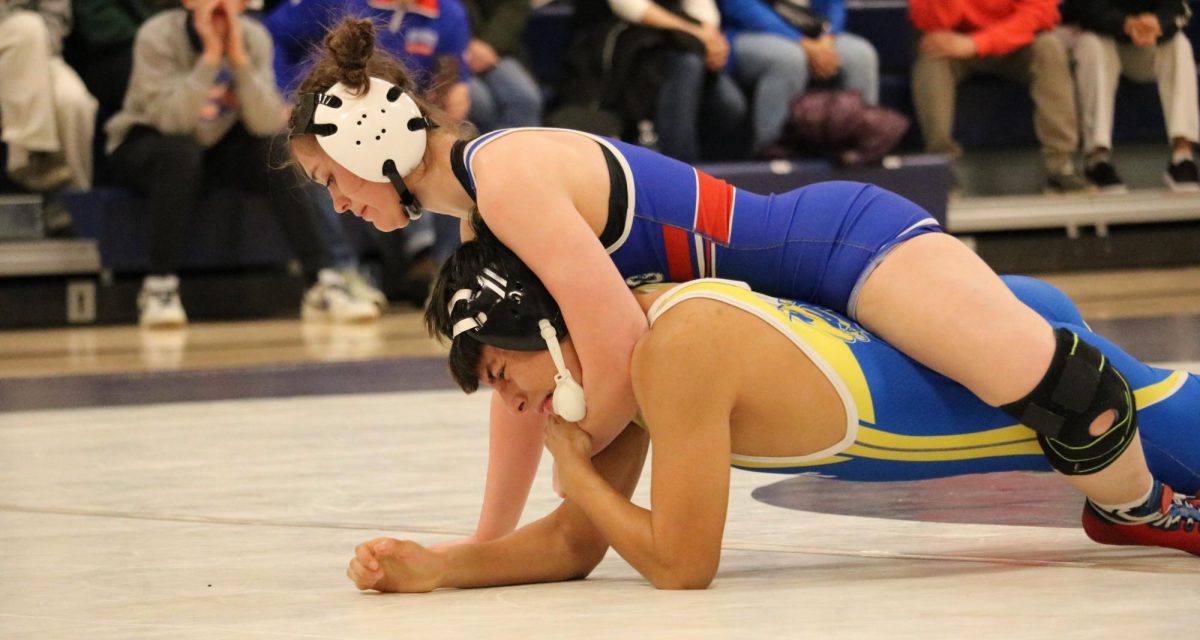

WOODBURY – Walking into the wrestling room for the first time of my sophomore season, I scanned the mats, hoping to see another girl, but it was just me: The only girl on an all-boys varsity team. For a moment, I wondered if I truly belonged. Last season, I had two other girls by my side, but they had since graduated or moved to a different district.
I thought my hardest battles would be conditioning or matches on the mats.
I was wrong.
Being on an all boys team meant wrestling not only opponents, but stereotypes, isolation, and constant pressure to prove I belonged. Every practice was a test of both strength and mental resilience; not only because of the sport’s intensity, but because I was learning how to navigate a space that didn’t feel like it was built with me in mind.
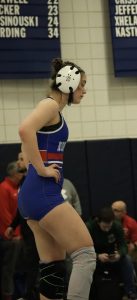
At first, I didn’t think much of being the only girl, but throughout the season the label of being “the girl on the team” started to show. While the boys had pep talks in the locker room before home meets, I sat in the hallway, wanting to feel that same camaraderie. As they exchanged inside jokes with one another, I repeatedly wondered to myself if this was really for me.
While boys got uniforms that fit their figures, I shoved myself into a boys singlet. I found myself in a uniform with a neckline that sat closer to my stomach than my neck, and a waistband hugging my hips so tight you could see every bone through the fabric. Each moment made me feel more of an outsider in this sport I love.
While I know my teammates meant no harm, I couldn’t let go of the feeling of how different I felt with everyone. With nobody there to share my struggles, my loneliness started to feel like a weight.
I’ve always wanted to experience being part of a team of all girls. A goal of mine is to wrestle in college, but that’s a struggle in itself. According to NCSA Sports, there are 146 college women’s wrestling programs across North America (102 in Div III, 38 in Div II, and 6 in Div I), while there are over 430 colleges that offer men’s only programs. Data like this underscores just how few programs are available to young females.
Every match felt more than just a competition to me. It was a statement.
If I lost, I risked people confirming that girls don’t belong in wrestling – especially if I lose to a boy. Winning felt like an expectation, not proof of my skill. This immense amount of pressure took a toll on my mental health. The constant mindset of wanting to outperform everyone, regardless of the situation, left little room for mistakes or self compassion.
Numbers on the scoreboard do not measure progress, but showing up when things are hard does. Every practice, every hit, and every time I got back up became the real victory. I didn’t always win, especially against bigger opponents, but each loss pushed me to work harder. Match after match, my determination grew stronger
To many, wrestling is seen as a “manly sport” and that perception forms a stereotype of how people treat and think of you. After some time, you get used to the comments. “She’s pretty strong for a girl” or “wrestling is a man’s sport, why are girls involved?”. While those comments may seem innocent or even complimentary, over time it chips away at your confidence.
Even something seemingly small as having fewer training partners, side comments and eye rolls, or people assuming I wrestle “less aggressively” because I’m a girl reinforces the idea that I’m an exception, not an equal.
Despite the challenges, I learned to find strength in the struggle as it built my confidence in ways nothing else could have.
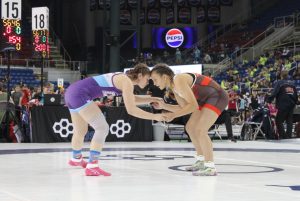
Over time, I began to carve out my own space on the team. I began researching young ladies such as Sarah Hildibrant and Amit Elor, who both struggled in similar ways as me, but ended up winning gold medals at the Olympics.
In 2024, Amit Elor won the Paris summer Olympics earning herself the title as the youngest female by becoming the youngest U.S. Olympic wrestling champion, male or female at 20 years old.
Seeing her determination and accomplishments showed me that hard work pays off and that it’s worth it in the end.
After a while, I met other girls in Connecticut and beyond who have had those challenges and we bonded over it, building our own community.
Being the only girl on the team forced me to find my voice, face discomfort, and redefine what I believe I could accomplish.
It is easy to get lost in defeat and forget how far you have come. Wrestling has taught me to focus on the small victories and view my success with these as the main measure of growth. This experience has shaped who I am as an athlete, a student, and person. I learned that staying true to yourself and putting in consistent effort always leads to growth. Sometimes, being the only one is not a disadvantage; it is a source of strength.