


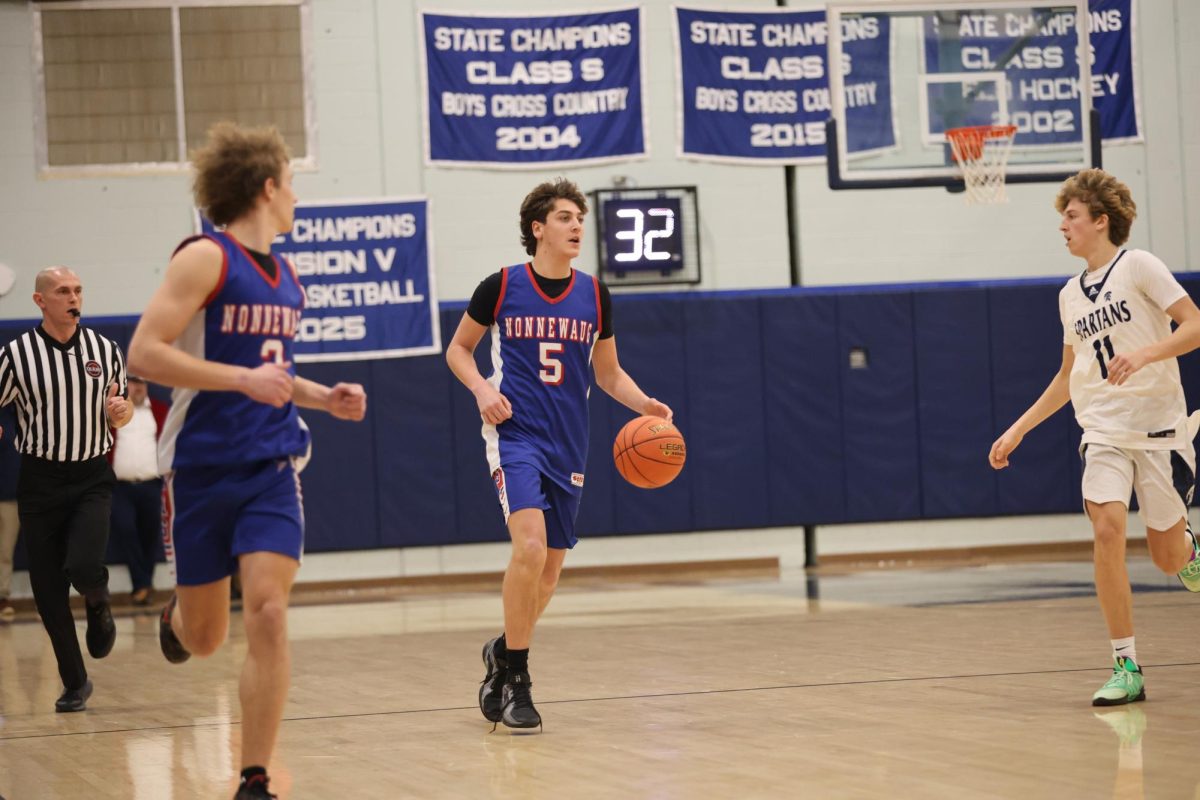

WOODBURY—After three years, the shot clock is a staple at Nonnewaug High School for basketball games; it ensures that on every offensive play, each team has 35 seconds to get a shot up before the other team gains possession.
The shot clock was added to every school in Connecticut three years ago, but when the survey came out to make the decision, Nonnewaug had some mixed opinions.
Declan Curtin, former NHS athletic director who was involved with the decision process of the shot clock, believes that budget was a big part of their choice.
“About three or four years ago the CIAC did surveys reaching out to all the districts on whether or not they would want the shot clock, cost was a huge factor, number one the cost of putting it in initially but also realizing that we pay our staff $69 for every game that is done,” Curtin said. “So some weeks you are adding three or four hundred dollars to the operating budget and at that point we believe that we should not vote for the inception of the shot clock; however, we were overruled by the state and everyone was required to have it.”
Even though Nonnewaug may not have been on board with the shot clock right away, three years later, the clock has helped out some players with their overall game.
Brady Herman, three year starter and captain on the basketball team thinks that sense the shot clock was put in, it makes the players take more risks.
“You make shots you didn’t expect to make because you have to shoot it,” Herman says. “Like Robert [Metcalfe] last week made a shot against Saint Paul at the shot clock buzzer that he wouldn’t normally shoot if there wasn’t a shot clock buzzer.”
Rebecca Pope, former girls basketball coach, realizes the differences between coaching with and without the shot clock.
“Adding a shot clock changes end of game scenarios the most,” Pope says. “Where you no longer can stall with the ball, the ball has to touch the rim within 35 seconds so it definitely changes how you coach in the end with a tight game and it also changes how players perceive offence.”
Bryce Gilbert, a sophomore on the girls team, who has been playing with the shot clock for two years now understands the stress that comes with the shot clock.
“Playing with the shot clock I feel like there’s a little bit more anxiety ‘oh I have to get the ball up’ ‘I have to shoot’ and I feel like without the shot clock it definitely slows the game down a lot more,” Gilbert said.
Robert Metcalfe, fellow boys basketball captain, sees the shot clock as a major factor in designing offensive sets.
“Most of our offense and attempted to score came later on with like 20 seconds left of the shot clock,” Metcalfe said. “We wasted like 10 seconds of trying to find open looks to try and waste the overall game clock.”
The shot clock has unquestionably impacted NHS basketball though the pass of the game is perhaps the most noticeable difference.
“Shot clock means you have to get the shot up in 35 seconds so that means we have to swing the rock, hopefully get a wide open shot within that time,” Herman said. “So I guess it definitely has made the game faster in general.”

![Nonnewaug junior Max Sorcher [left] gifts Alex Pereira a Danbury Hat Tricks jersey. Pereira will be fighting Cyril Gane in the white house on June 14th.](https://nhschiefadvocate.org/wp-content/uploads/2026/06/IMG_8418-1200x900.jpeg)


